Metallicities and galaxy morphologies with JWST
I am involved with multiple grism spectroscopic surveys of the James Webb Space Telescope (JWST), with the aim of characterizing galaxy evolution in the first few billion years. I am working on the PASSAGE survey (GO-1571; PI: Malkan) to understand the cycling of matter in and out of galaxies during the peak epoch of galaxy formation (redshifts 1-3, or 8-10 Gyr ago). I am studying how the well-known scaling relations between stellar mass and metallicity (mass-metallicity relation) and star formation rate (fundamental metallicity relation) vary as functions of various morphological characteristics of galaxies, including size and projected shape. I am also working on the POPPIES survey (GO-5398; PI: Kartaltepe & Rafelski) to extend some of these analyses to higher redshifts (the first billion years).
The cosmic web and its role in galaxy formation
Galaxies are known to be woven into a complex spider web-like network of very large-scale structures that we call the cosmic web. But the physical connection between these extremely disparate scales -- galaxies are on the order of kiloparsecs in size, while cosmic web structures are >Megaparsecs in size -- remains unclear. I have used a combination of theoretical cosmological simulations and real galaxy survey data to understand how the cosmic web impacts critical galaxy formation processes such as star formation and emergence of morphological structure across cosmic time.
How the cosmic web affects galaxy Morphologies and what the Roman Space Telescope will find
In Hasan et al., (2026), we used cosmological simulations to predict what role the early (redshift >1) cosmic web played in regulating morphological properties of galaxies such as 3D shape, spin, and size. We found that early compact and elongated (cigar-shaped) galaxies are associated with low-density filaments of the cosmic web, while rotationally-supported disk galaxies prefer higher density filaments. We also predicted the early cosmic web structure that can be identified with galaxy surveys from NASA's next great observatory, the Nancy Grace Roman Space Telescope.
Gas and star formation in the cosmic web: observations vs. simulations
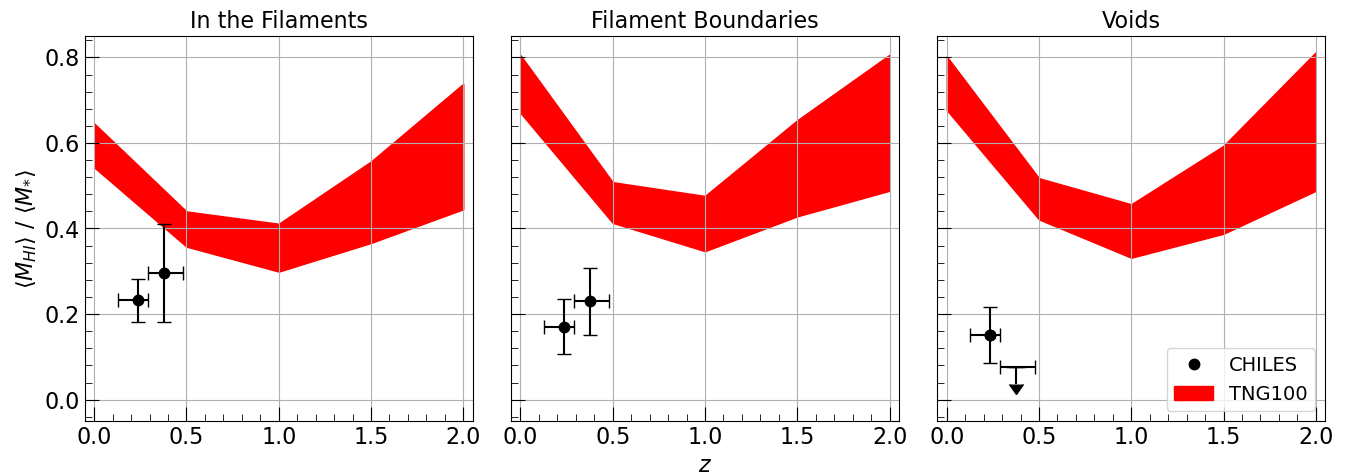
In Luber, Hasan et al., (2025), we compared theoretical simulation predictions with observed data from ground- and space-based observatories on the cosmic web-dependence of neutral hydrogen (HI) gas and star formation activity at later times (redshifts < 0.5). The simulations predict that void galaxies are the richest in HI and most star-forming, exactly opposite the trend observed by the 21 cm CHILES survey.
Using slime mold to reveal the cosmic web
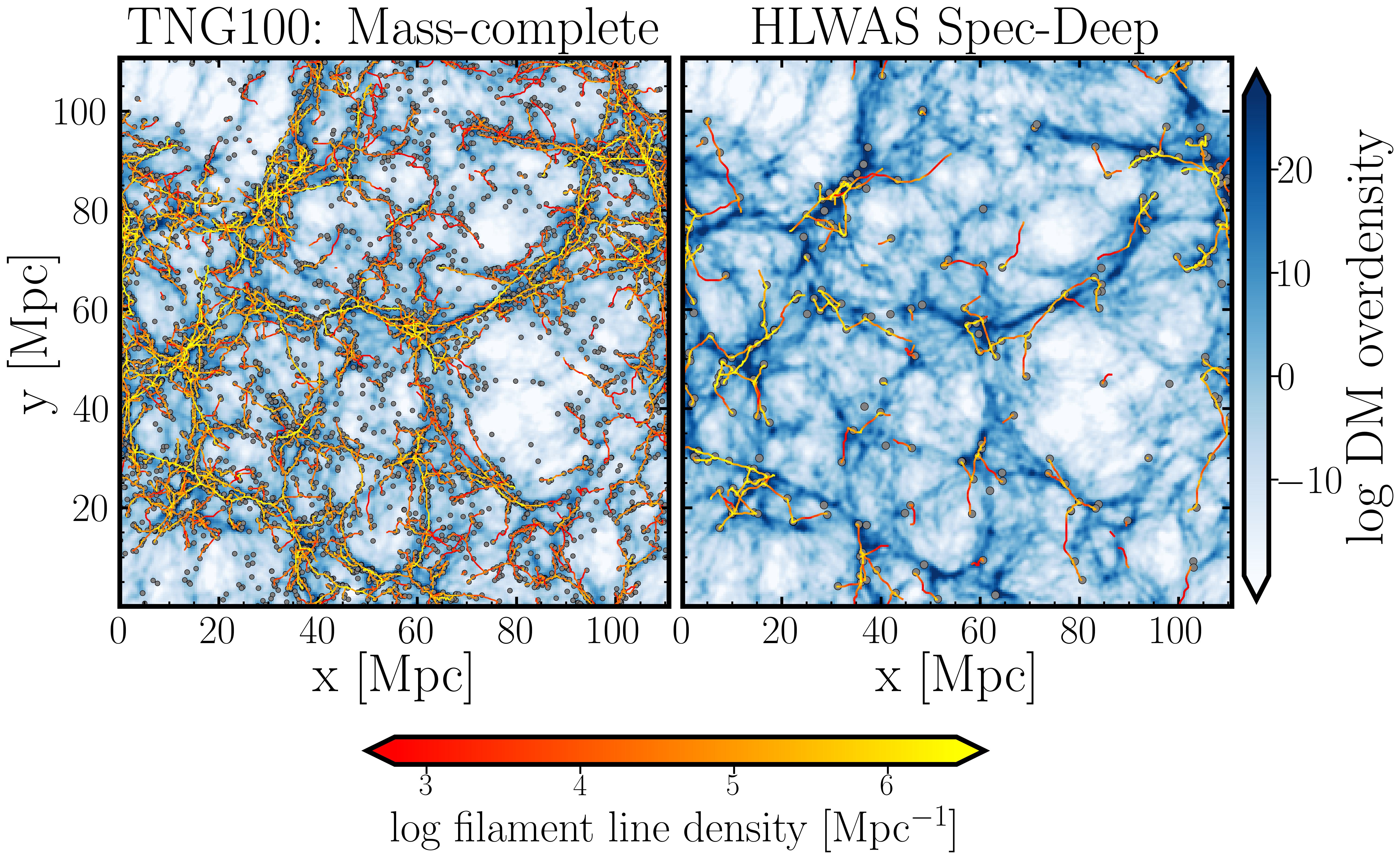
In Hasan et al., (2024), we developed a new method to identify filamentary structures from galaxy data, by taking inspiration from how the unicellular slime mold organism grows here on Earth. More details of the Monte Carlo Physarum Machine algorithm mimicking slime mold can be found here. Our method, directly applicable to observed data, is able to more accurately model cosmic matter distribution from sparse galaxy samples than long-established techniques, helping us characterize the diversity of filamentary structures according to their 1D line density.
How the cosmic web affects star formation quenching and gas supply
We predicted how the cosmic web affects the star formation activity and gas content of galaxies in two separate papers.
In Hasan et al., (2023), we showed that galaxies lose their gas and stop forming stars when they live close to filaments and nodes - but only at redshifts <2 ; at earlier times, there is no statistical effect of distance to the cosmic web.
In Hasan et al., (2024), we found that galaxies near high-density filaments are likely to be gas-poor and quenched at later times, but hardly any effect exists at early times.
Satellite galaxies appear to dominate the trends, but an effect of filaments persists even after controlling for local environmental effects.
Mapping the gas in cosmic filaments
I am leading a Hubble Space Telescope (HST) archival research program (AR-17568; PI: Hasan) in which we are applying our slime mold-inspired techniques to galaxies observed in the Sloan Digital Sky Survey to identify cosmic web filaments in the real Universe out to redshift ~0.5. We will constrain the gas distribution in cosmic filaments using absorption features in background HST/COS quasar spectra passing through the filaments.
Metal enrichment of cosmic ecosystems
Metals are crucial tracers of galaxy formation processes as virtually all of them were made by stars. By tracing metals in cosmic ecosystems, we can therefore probe cosmic star formation activity as well as related phenomena such as the background radiation produced by galaxies. I investigated absorption lines arising from metals imprinted on background quasar spectra to constrain constrain the history of metal enrichment and ionizing radiation of the Universe across ~13 billion years.
The evolution of metals and gaseous galaxy halos
In Hasan et al., (2020), I led a large survey of ionized carbon (CIV) absorption features in high-resolution quasar spectra from Keck and VLT. We found that stronger (more optically thick) CIV absorbers evolve more rapidly at later times than the far more abundant weaker (optically thin) absorbers. We deduced that only optically thick metals closely trace cosmic star formation activity. In Hasan et al., (2022), we developed a statistical model based on our survey to estimate the spatial extent of gaseous galaxy halos containing metals. We showed that optically thin metals are likely to reside past galaxy halos, while optically thick metals typically live far closer to galaxy centers.